
AI Agents Are Visiting Your Site. Can They Actually Use It?
Assistive agent optimization (AAO) is the practice of making your website readable, navigable and actionable for AI agents that browse on a person's behalf. An agent does not look at a page the way a human does. It parses the structure, follows the links, reads the forms and decides whether the task it was given can be completed here. If your site resists that, the agent moves on to a competitor and your customer never learns you existed.
This is already happening. The agent modes inside ChatGPT, Claude, Gemini and Perplexity open real pages, compare real options and fill in real forms. YuvGro makes sure that when one of them arrives on your site, it can read what you sell, understand who you are, and finish the job your customer asked it to do.
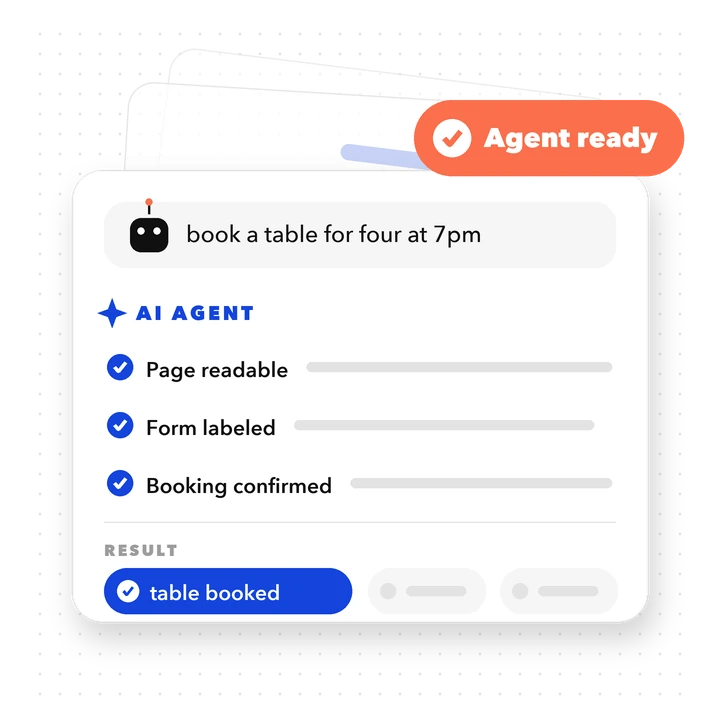
Optimizing for a Visitor That Has No Eyes
An assistive agent is software that acts for a user. It opens pages, reads them, clicks through, and either reports back or completes the purchase itself. It has no patience for a layout that only makes sense visually, for content that appears after a script runs, or for a form whose fields carry no labels. What it needs is clean semantic markup, text that is present in the HTML, labeled controls, predictable navigation and a server that answers it instead of blocking it.
AAO is the layer underneath AEO, GEO and AIO. Those disciplines decide whether an AI system mentions you in its answer. AAO decides whether it can actually reach you, read you and act once it tries. A brand can win the citation and still lose the sale, because the agent met a bot challenge, a price that only exists in JavaScript, or a checkout it could not operate.
Agentic browsing readiness scored on both mobile and desktop for the last client site we took through this work.
Growth in appearances inside Google AI features across three months on that same site.
The status code one major host kept returning to AI crawlers while the site's robots.txt openly invited them in.
Why AI Agents Give Up on Your Website
Your host quietly blocks the agents you want
Plenty of hosting stacks, firewalls and security plugins answer AI crawlers with a 403, a 429 or a bot challenge, even when robots.txt welcomes them. Nothing in your analytics shows it, because a blocked request never becomes a session. The agent simply never arrives and you assume your content was not good enough.
Your content only exists after JavaScript runs
If the price, the availability or the service description is painted in by a script after load, many agents never see any of it. They read what the server sent. A page that looks complete in a browser can be close to empty to the system deciding whether to put you on the shortlist.
Your forms and buttons cannot be operated
Inputs with no labels, buttons built from generic containers, and flows that depend on hovering or dragging are all dead ends for an agent. It can reach the exact moment of action and still be unable to take it, which is the most expensive place on the whole site to fail.
Nothing on the page states what you are or what you charge
With no structured data, an agent has to infer your category, your location, your hours and your pricing from prose, and it will often get it wrong. Competitors who publish that information in a machine readable form get compared accurately. You get left out of the comparison altogether.
Everything Needed to Make Your Site Agent Ready
+ Agent Access Audit +
+ Crawler and Firewall Remediation +
+ Server Rendered Content Review +
+ Semantic Markup Rebuild +
+ Operable Form and Checkout Pass +
+ Structured Data Built for Agents +
+ llms.txt and Agent Directives +
+ Quarterly Agent Readiness Retest +
Every deliverable is tailored to your business, market, and goals.
What Agent Ready Looks Like in the Numbers
Agentic Browsing Score, mobile and desktop, after remediation
Growth in AI Feature Appearances, three months against the prior three
Appearances Inside AI Features in a single quarter, against 42 before
Organic Clicks in Four Months on that same site, from a standing start
Assistive Agent Optimization Questions, Answered Clearly
What is assistive agent optimization? +
How is AAO different from AEO, GEO and AIO? +
Which AI agents does this cover? +
How would I know if agents are being blocked right now? +
Does AAO improve accessibility as well? +
How long does it take? +
Is this worth doing while agent traffic is still small? +
STOP GUESSING. START growing.
15 minutes. No pitch. Just insight.