
Multi Location SEO Services
Multi-Location SEO Services That Scale Past 5 Locations.
Most local SEO advice assumes you have one address. The moment you have twelve, the rules change: your locations start competing with each other, your Google Business Profiles drift out of sync, and the location pages your developer generated from a template get treated as doorway pages.
We build multi-location SEO programmes for brands running 5 to 500 locations anywhere in the world: the architecture, the profile management, and the measurement that keeps every location visible without cannibalising the others.
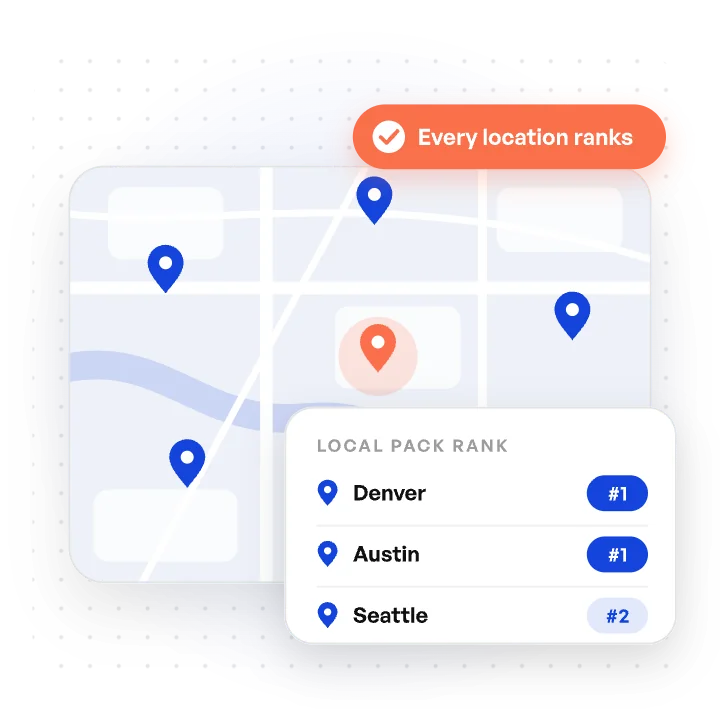
Multi-Location SEO Is an Architecture Problem Wearing a Ranking Problem's Clothes
Single-location SEO is a ranking problem. Multi-location SEO is a structural one. Three failures account for most of it: template collapse, where location pages generated from one template with the city name swapped in are treated as near-duplicates and only a fraction get indexed; internal cannibalisation, where two locations in the same metro target the same phrase and Google picks one while suppressing the other; and NAP drift, where name, address and phone data entering from the POS system, the franchise directory, the old agency's citation build and three aggregators leaves the same location existing in four contradictory forms.
None of these are fixed by publishing more content. They are fixed by structure, which is why every engagement starts with an audit rather than a content calendar.
The structural decision that matters most is where location pages live. For the overwhelming majority of brands the answer is subdirectories - yourbrand.com/locations/city-name/ - because you are building one authoritative domain, not fifty weak ones. Subdomains and separate domains split ranking signal across properties that each have to earn trust independently, and are only appropriate where franchisees legally own their own marketing.
Why Multi-Location SEO Breaks at Scale
Template collapse
Location pages generated from one template with the city name swapped in are near-duplicates. Google classifies them as doorway pages and indexes a fraction. Ten locations become three indexed pages, and nobody notices until traffic plateaus. If your pages differ only by city name, you do not have location pages, you have one page and a find-and-replace.
Internal cannibalisation
Two locations in the same metro target the same phrase. Google picks one, suppresses the other, and the suppressed location's paid budget quietly starts covering for organic that never arrives.
NAP drift
Name, address and phone data enters from the POS system, the franchise directory, the old agency's citation build and three aggregators. Within a year the same location exists in four contradictory forms, and Google's confidence in all of them drops.
Two locations in one city filtering each other out
Google ranks one result per query per user location in most local contexts, so two branches four miles apart get filtered against each other. You cannot fully prevent this, you can only direct it: differentiate by service rather than geography, target the neighbourhood instead of the city, and let proximity weighting serve two catchments.
What a Multi-Location Programme Covers
+ Location page architecture and URL structure +
+ Google Business Profile management at scale +
+ NAP consistency and citation cleanup +
+ Same-city differentiation strategy +
+ Vertical-specific structures +
+ Per-location measurement +
Every deliverable is tailored to your business, market, and goals.
From $799 a month. Every package is scoped to your goals and the market you sell into. See what each package includes
Multi-Location SEO Questions, Answered
How do you do local SEO for multiple locations in one city? +
What is the best URL structure for multi-location SEO? +
How long does it take a new location page to rank? +
How do you manage multiple locations in Moz Local? +
How much does multi location SEO cost? +
How many locations do you need before this is worth buying? +
How do you stop location pages being duplicate content? +
Who manages the Google Business Profiles, you or our teams? +
Does this work for service area businesses with no storefront? +
What happens when we open or close a location? +
STOP GUESSING. START growing.
30 minutes on Google Meet. No pitch deck. Just a plan you can act on.